The Only 4 Chords You Need to Start Writing Songs
By Bedroom Musician Press · June 30, 2026
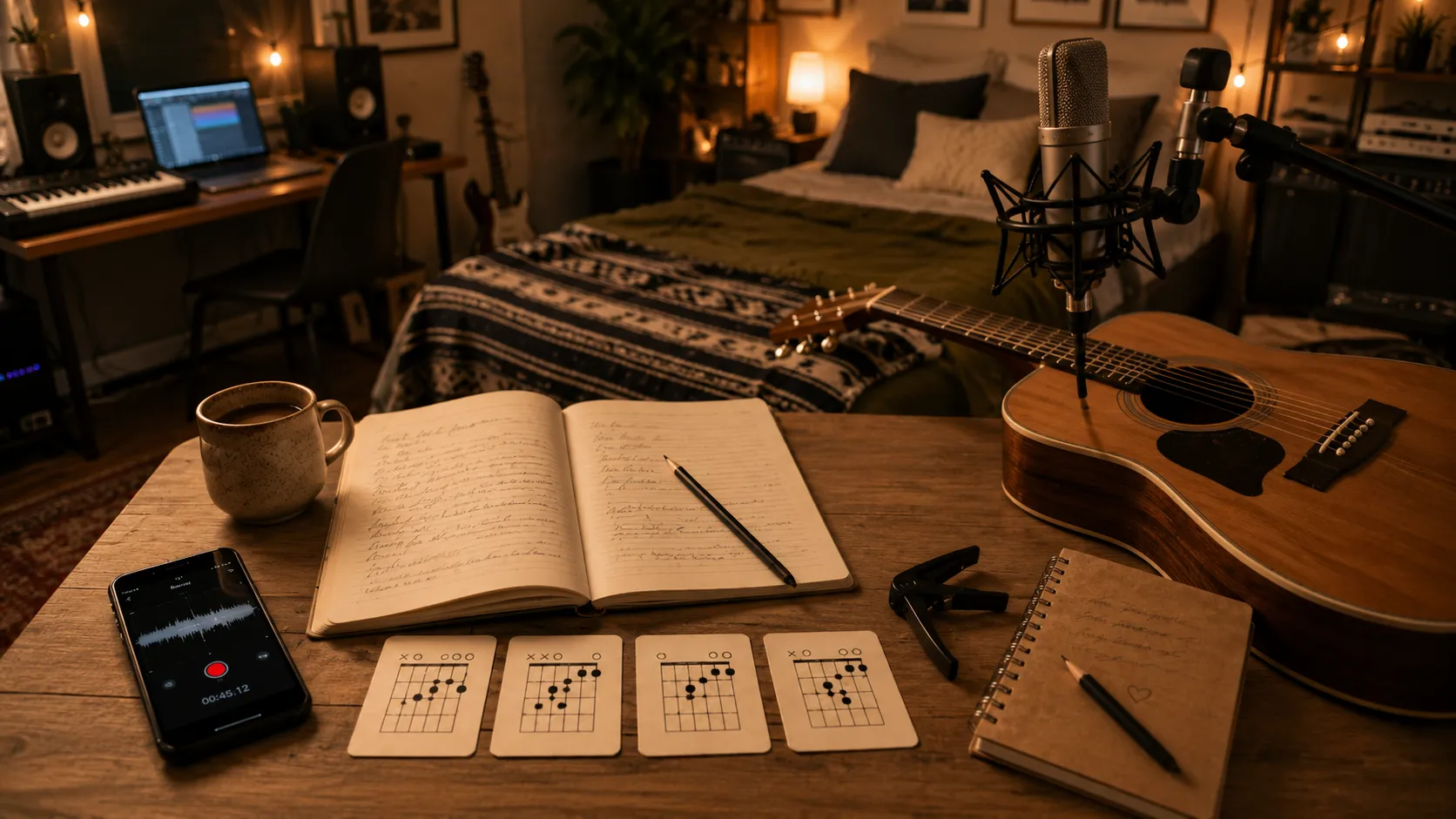
You do not need to know every chord on guitar to start writing songs.
You do not need to understand advanced music theory.
You do not need to memorize the entire fretboard before you are allowed to create something.
If you are a beginner songwriter, you need a small group of chords that are easy to play, easy to loop, and flexible enough to support different moods.
Start with these four:
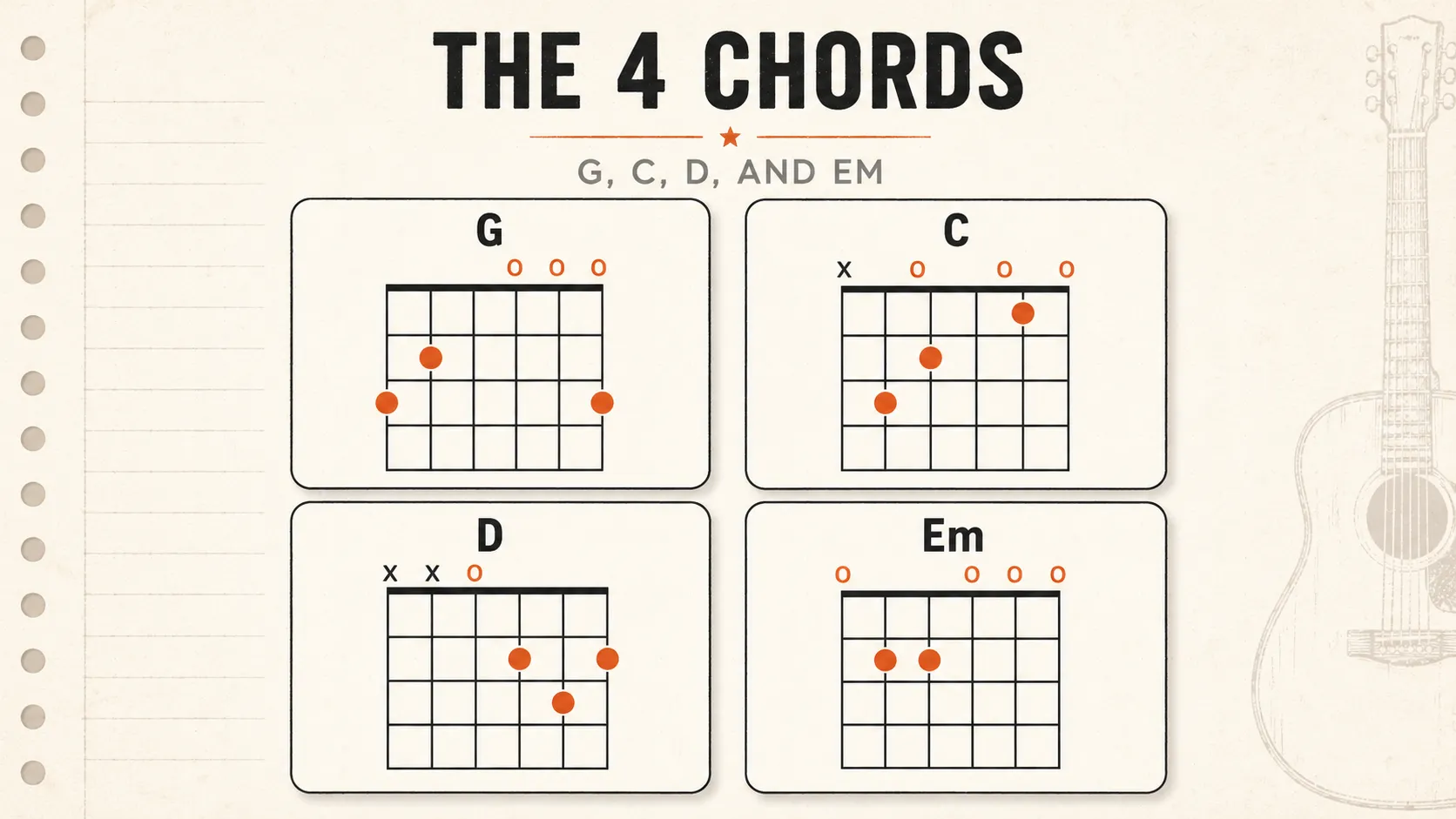
G, C, D, and Em.
That is enough to get a song moving.
Why These 4 Chords Work So Well
A lot of beginners get stuck because they think songwriting starts with knowing more.
More chords.
More scales.
More theory.
More guitar tricks.
But most songs do not begin with complexity. They begin with movement.
A few chords repeat. A melody shows up. A phrase starts to feel like a chorus. A random voice memo turns into something you can actually build on.
That is why these four chords are useful.
They are simple enough for beginners, but strong enough to write real songs with.
The 4 Chords
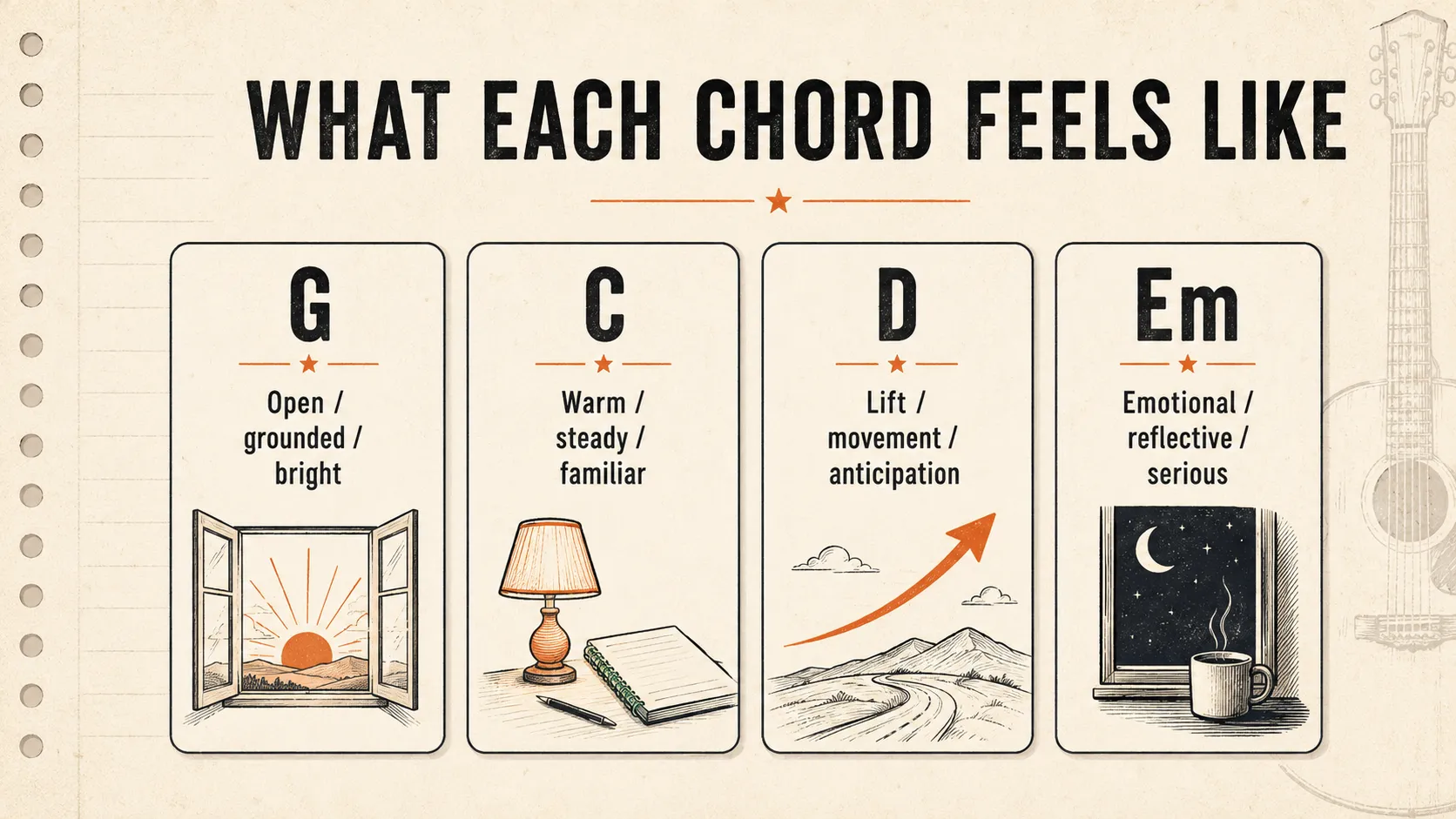
G
G feels open, bright, and resolved.
It is a good chord to start on when you want the song to feel grounded. If your idea feels hopeful, honest, or straightforward, G can give it a strong starting point.
C
C feels warm and steady.
It works well when you want the song to feel familiar or emotional without getting too dark. C is also a good chord to move to when you want the progression to feel like it is opening up.
D
D creates lift and movement.
It often feels like the song wants to go somewhere. If G feels like home, D feels like the moment before the song comes back home.
Em
Em adds emotion.
It is the minor chord in this group, which means it can make a progression feel more serious, sad, reflective, or personal.
You do not need to overthink this.
Just remember:
G feels open. C feels warm. D adds lift. Em adds emotion.
Three Progressions You Can Use Today
Once you know these four chords, you can rearrange them into different progressions.
A progression is just a repeating pattern of chords.
You do not need to invent something complicated. Pick one pattern, loop it, and start singing or humming over it.
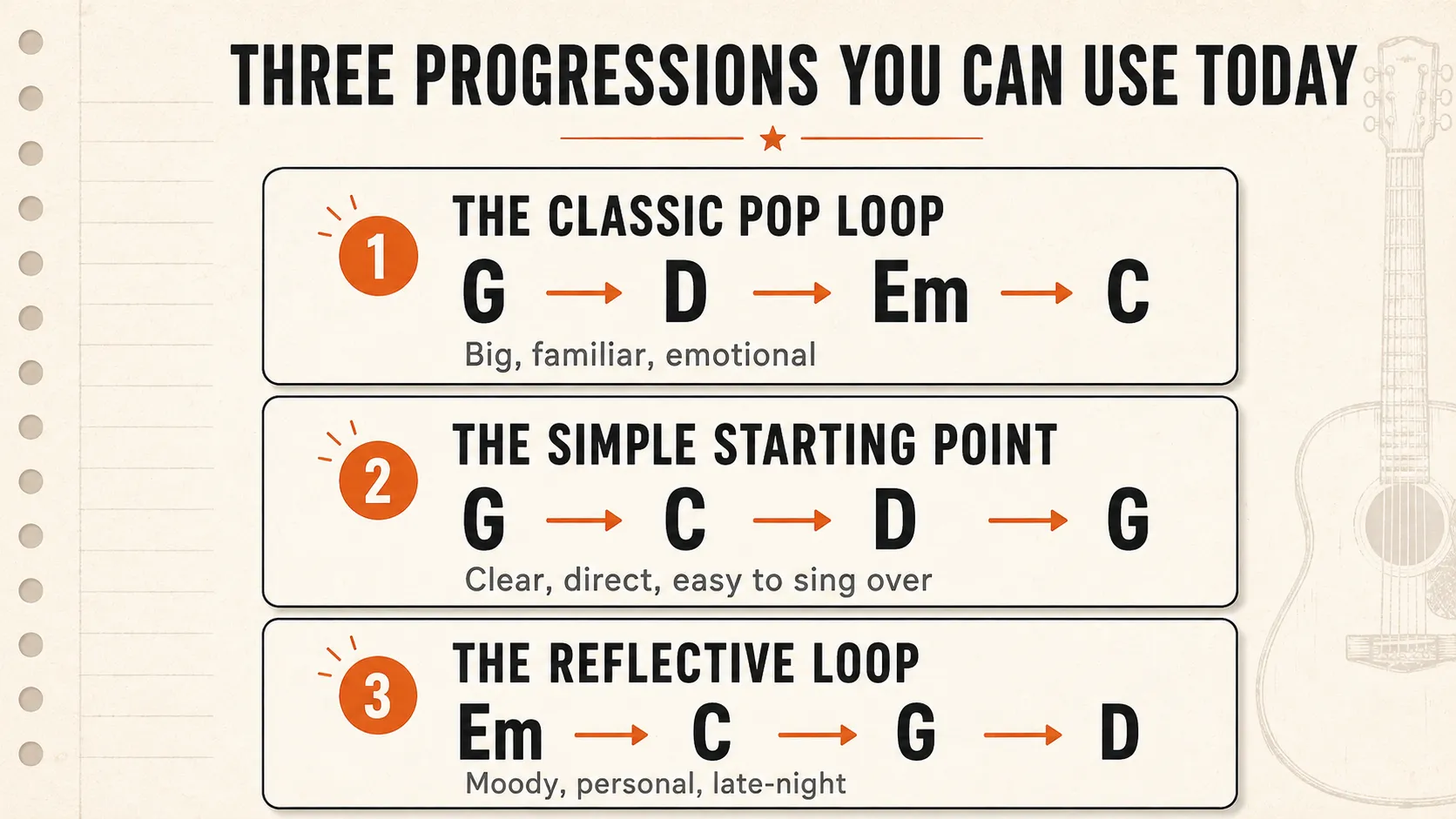
Progression 1: The Classic Pop Loop
G – D – Em – C
This is one of the most useful beginner progressions because it has a big emotional shape.
It starts open, lifts, gets emotional, and then settles into warmth.
Use this when your song needs a familiar, emotional feeling.
Good for:
- pop ideas
- worship ideas
- country ideas
- singer-songwriter ideas
- emotional choruses
Try playing each chord for four counts:
G, 2, 3, 4 D, 2, 3, 4 Em, 2, 3, 4 C, 2, 3, 4
Then loop it.
Do not try to write the whole song yet. Just hum one melody over it.
Progression 2: The Simple Starting Point
G – C – D – G
This progression is clear, simple, and easy to follow.
It feels direct. It does not try to be too dramatic. It is a good option when you want to write something honest and straightforward.
Use this when your song idea feels simple, conversational, or story-based.
Good for:
- folk songs
- country songs
- simple acoustic songs
- beginner verses
- storytelling lyrics
Try using this progression under a verse.
Sing one plain sentence over it. Something you would actually say in real life.
For example:
“I drove around the block again.”
That does not have to be your final lyric. It is just a starting point.
The point is to get the song moving.
Progression 3: The Reflective Loop
Em – C – G – D
This progression starts with emotion first.
Because it begins on Em, it immediately feels more serious or reflective. This is useful when your idea feels sad, personal, nostalgic, or late-night.
Good for:
- sad songs
- emotional verses
- reflective hooks
- personal lyrics
- slower ideas
Try this if your voice memo already feels moody or vulnerable.
Start by singing one honest line over Em.
Then let the rest of the progression carry the feeling forward.
How to Actually Use These Chords to Start a Song
Knowing the chords is not enough.
You need to use them in a simple process.
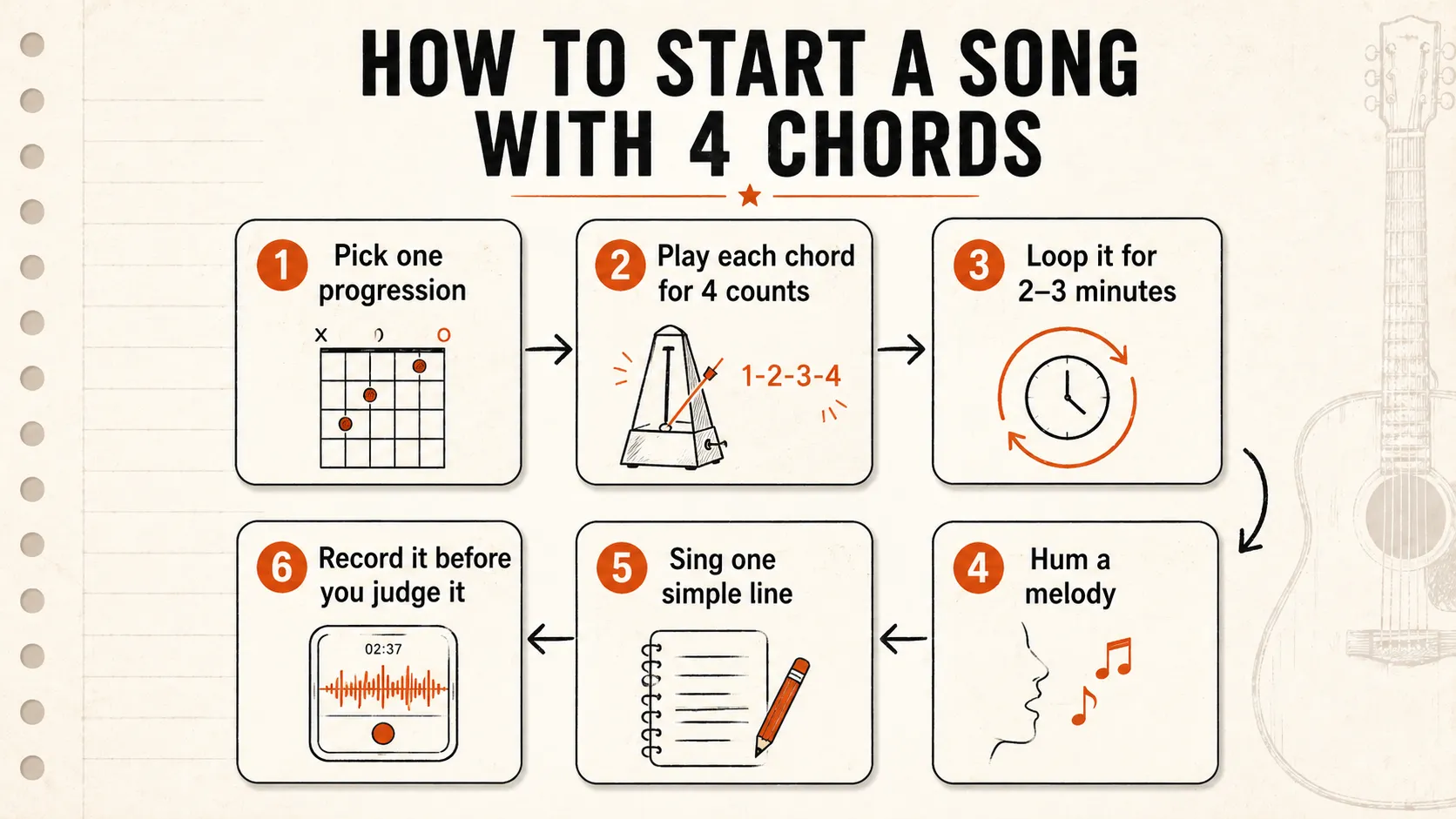
Here is the easiest way to start:
- Pick one progression.
- Play each chord for four counts.
- Loop the progression for two or three minutes.
- Hum a melody over it.
- Sing one simple lyric line.
- Record a rough voice memo.
- Do not judge it yet.
That last step matters.
Most beginner songwriters stop too early because they start judging the idea before it has a chance to become anything.
The first version does not need to be good.
It just needs to exist.
Do Not Wait for the Perfect Chord
A lot of unfinished songs stay unfinished because the writer keeps searching for the perfect chord.
But at the beginning, the perfect chord is not the goal.
Movement is the goal.
If the progression gives you enough support to sing over it, it is doing its job.
You can change the chords later.
You can make the rhythm better later.
You can rewrite the lyrics later.
But first, you need something real to work with.
A rough song you can play from beginning to end is more useful than a perfect chord idea that never becomes a song.
Start With Four Chords
G, C, D, and Em will not teach you everything about songwriting.
But they will give you a place to start.
And for most beginner songwriters, that is the most important thing.
You do not need 100 chords.
You need a few chords you can actually use.
Pick one progression.
Loop it.
Hum something.
Write one line.
Record it before you judge it.
That is how an idea starts becoming a song.
free download
Download the Free Chord Progression Cheat Sheet
G, C, D, and Em on one page — with chord diagrams and three beginner progressions you can use today.
Get the free cheat sheet →